
Why Self AV Fistula Examination Matters?
Self AV Fistula Examination regularly allows patients to spot any changes in the appearance of their AV fistula/ graft that could indicate that the fistula/ graft has narrowed or formed clots. Finding issues at an early stage will help stop any serious consequences of these problems and decrease the patient’s visit to go to the emergency room for an intervention. Patients who consistently self-examine their AV fistula/ grafts are better equipped to report any problems they encounter to their dialysis team or vascular access surgeon.
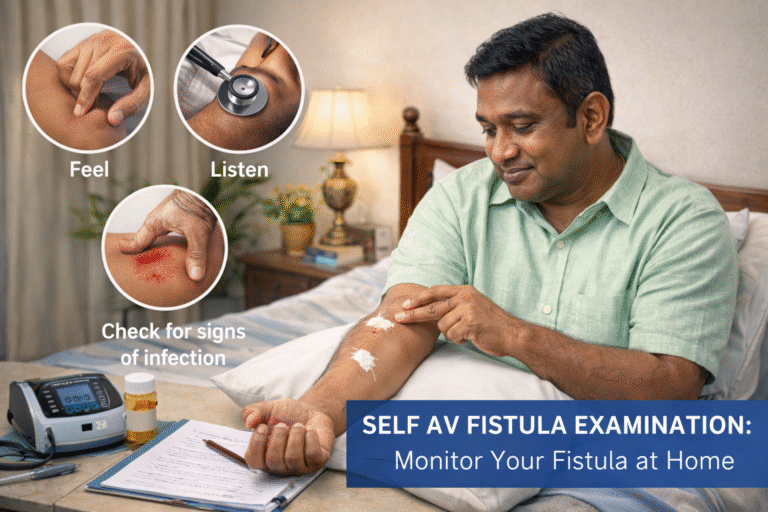
Consent have been given by patient and relatives to use this video for educational purpose
Self AV Fistula Examination: Simple Steps for Patients
The process of Self AV Fistula Examination is easy to learn and can be done at home by following a few simple steps:
- Know your fistula type: Find out whether your fistula is radiocephalic, brachiocephalic, or brachiobasilic. Knowing the type of fistula you have helps you understand where to examine it properly for regular monitoring.
- Learn how to use a stethoscope: You will be taught how to correctly hold and place the stethoscope over your fistula so that you can clearly hear the blood flow.
- Listen for a continuous sound: Use the stethoscope to listen for a continuous bruit, which indicates that blood is flowing normally through your fistula.
- Mimic gentle downstream compression: By gently squeezing the distal (lower) end of your fistula while listening with the stethoscope, you can simulate a condition similar to thrombosis. This will cause the sound to become interrupted.
- If the sound changes, do not panic: A change or interruption in sound does not always mean a serious problem. It may occur due to low blood volume, reduced blood flow, or changes in blood pressure. Monitor your blood pressure (BP), and if you notice the sound change again, recheck your BP once it is stabilized.
- Regularly validate your self-examination with your doctor: Sharing your self-examination findings with your doctor helps in accurate monitoring and long-term care of your fistula.
- Emergency alert: If you are unable to hear any sound at all or notice no response, contact your healthcare provider immediately, as this may indicate a blocked (thrombosed) fistula.
As stenosis becomes critical – this sound progresses to low pitch – systolic only bruit
Points of Caution During Self AV Fistula Examination
- When blood pressure drops, the constant sound that is associated with the AV Fistula may become temporarily interrupted (rather than being continuous). Mild to moderate levels of narrowing in an AV Fistula usually produce a continuous sound; therefore, some Self AV Fistula Examination will only detect severe narrowing of an AV Fistula.
- If a person has persistent interrupted sounds, they should be evaluated by the patient’s AVF surgeon promptly.
Training and Evaluation
Every patient who learns how to do a Self AV Fistula Examination has been pre- and post-evaluated to verify they can detect any alteration of their AVF. This means that through actual training with a stethoscope and having an AVF surgeon provide encouragement, patients have been or are prepared to check on their own vascular access without feeling insecure or unqualified to do so.
Conclusion
For dialysis patients, mastering how to perform Self AV Fistula Examination is a vital skill. Self-examination helps ensure safety and encourages patients to be actively involved in their own care while allowing for early detection of problems or complications with the fistula. Ongoing monitoring by the patient through self-examination, execution of a self-examination using the correct technique, and prompt reporting of any abnormalities found during self-examination will lead to improved outcomes from dialysis treatments and a healthy AV fistula.
FAQs
How often should I perform Self AV Fistula Examination?
It is suggested to examine your fistula daily or just before your next dialysis appointment.
Can low blood pressure affect the sounds during Self AV Fistula Examination?
Yes, if your blood pressure is low, it could make your continuous sound like an interrupted sound. When your blood pressure returns to normal, you should recheck your examination.
What should I do if there is no sound?
If you do not hear anything when examining your AV Fistula/ graft, it likely means you have a blood clot. You should contact your doctor as soon as possible.
Can mild stenosis be detected by Self AV Fistula Examination?
Self-examinations can usually detect severe levels of stenosis, while mild to moderate levels of stenosis generally produce a continuous sound.
Is special training required for Self AV Fistula Examination?
Yes, it is important for patients to receive the necessary training to enable them to correctly detect variations and make appropriate decisions based on that information. The AVF Care Workshop provides patients with practical experience and training in this area.
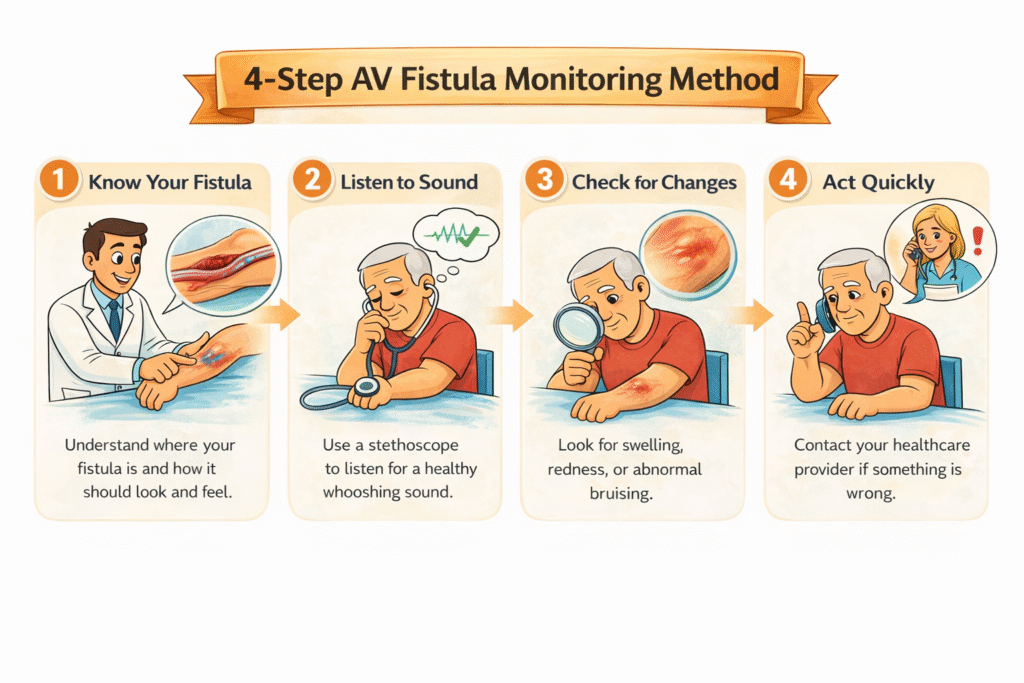
4-Step Self Fistula Check
Your AV fistula is your lifeline for dialysis.
Checking it daily takes less than one minute – but it can prevent serious complications.
Here is the simple 4-step method Self AV Fistula Examination.
Step 1 – Know Your Fistula
- Identify your usual first needle puncture site (where dialysis typically begins).
- Understand that this is the best point for daily sound monitoring.
- Sit in a quiet place before checking.
You are simply becoming familiar with your own AV access during Self AV Fistula Examination.
Step 2 – Use the Stethoscope Correctly
- Place the earpieces comfortably in your ears.
- Hold the round flat part (diaphragm) gently.
- Place it on the first needle puncture site.
- Do not press too hard.
- Keep it steady — do not move it around.
No technical training required.
Step 3 – Listen for Changes
You are checking only one thing: the sound during Self AV Fistula Examination..
✔ Continuous whooshing sound → Normal flow
A steady, uninterrupted sound means your fistula is functioning well.
⚠ Interrupted or weak → Possible narrowing (stenosis) of types of AV access for dialysis
Inform your dialysis team.
🚨No sound at all → Urgent review needed
Disclaimer: – In case of very low pulse rate or low blood pressure sound can be weak/interrupted. Don’t panic check your blood pressure and pulse rate. If it is normal then you re check after sometime and if weak/interrupted sound persist contact your nearest AV fistula surgeon.
Contact your AV Fistula Surgeon immediately.
That’s it.
No complicated medical terms.
Just listen daily as part of your Self AV Fistula Examination.
Step 4- Act Quickly
Most fistula blockages do not happen suddenly.
They begin with narrowing (stenosis).
If detected early:
- Angioplasty can restore flow
- Surgery can often be avoided
- Dialysis continues smoothly
Early listening saves fistulas.
Most fistula blockages do not happen suddenly.
They start with narrowing (stenosis).
If detected early:
- Angioplasty can fix it.
- Surgery can be avoided.
- Dialysis continues smoothly.
Early listening saves fistulas.
Want to Learn More about Self AV Fistula Examination?
If you would like detailed training, live demonstration, or want to join the AVF Care Workshop, please contact us.
Our structured workshop teaches:
- How to identify normal and abnormal sounds during Self AV Fistula Examination
- When to report changes
- How to protect your fistula long-term
📩 Email: avfcareworkshop@gmail.com
📍 AVF Care Program – Department of Vascular Surgery
Fortis Memorial Research Institute, Gurgaon, India
(Workshops available for dialysis centers, technicians, and patient groups.)
Scientifically Proven Program
This Self AV Fistula Examination is not just advice – it is scientifically studied and published.
Our structured AVF Care Workshop model has been evaluated and published in:
-Dr. Trisha Sachan Misra, Chanderkanta, Sanoj Yadav, Dr, Himanshu Verma.
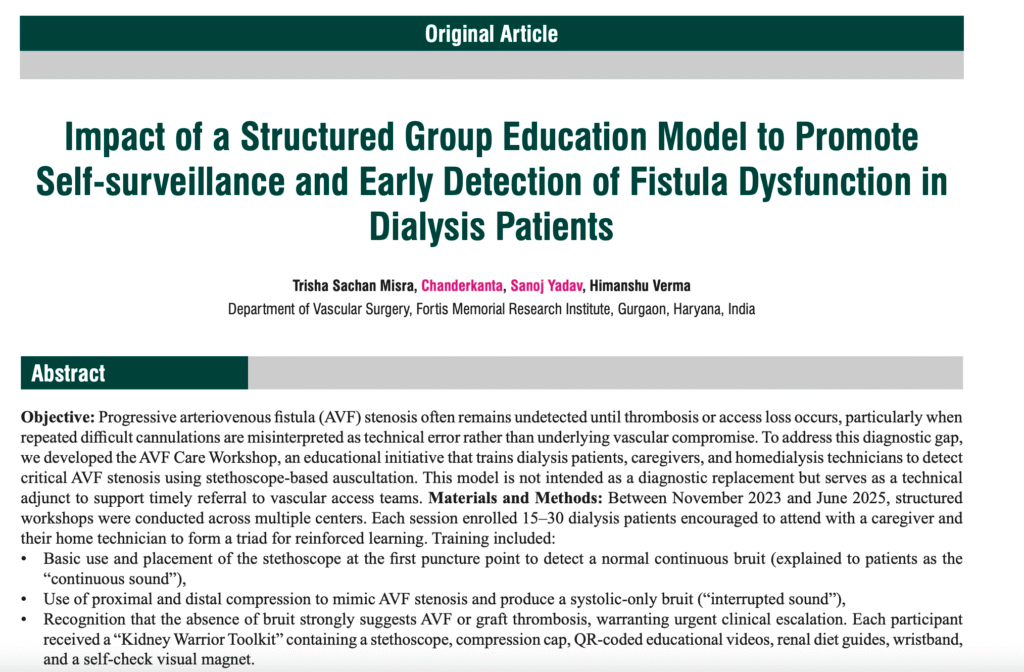
Impact of a Structured Group Education Model to Promote Self-surveillance and Early Detection of Fistula Dysfunction in Dialysis Patients.
Indian Journal of Vascular and Endovascular Surgery, 2026.
The study demonstrated:
- High accuracy in patient-detected narrowing
- Early referral
- 96.7% successful fistula salvage rate
This confirms that simple daily listening can make a real difference.
FAQs
How often should I perform Self AV Fistula Examination?
It is suggested to examine your fistula daily or just before your next dialysis appointment.
Can low blood pressure affect the sounds during Self AV Fistula Examination?
Yes, if your blood pressure is low, it could make your continuous sound like an interrupted sound. When your blood pressure returns to normal, you should recheck your examination.
What should I do if there is no sound?
If you do not hear anything when examining your AV Fistula/ graft, it likely means you have a blood clot. You should contact your doctor as soon as possible.
Can mild stenosis be detected by Self AV Fistula Examination?
Self-examinations can usually detect severe levels of stenosis, while mild to moderate levels of stenosis generally produce a continuous sound.
Is special training required for Self AV Fistula Examination?
Yes, it is important for patients to receive the necessary training to enable them to correctly detect variations and make appropriate decisions based on that information. The AVF Care Workshop provides patients with practical experience and training in this area.

